Language


 脑瘤,卞修武院士,胶质母细胞瘤
 z-bio
z-bio
 2025-08-26
 4599
4599
Glioblastoma (GBM) is the most common and aggressive primary brain tumor
with a very poor prognosis in patients and a median survival period usually does
not exceed 15 months. In recent years, more and more studies have shown that GBM
does not exist in isolation, but can interact closely with peripheral neural
circuits, and even integrate into neural networks to promote its own
proliferation and invasion through neural activity.
Previous studies have focused on the role of glutamategic signals in tumor
progression, but little is still known about how other neurotransmitter systems
(such as the cholinergic system) participate in regulating GBM, especially
long-range neural input.
On August 18, 2025, Chen Tunan, Bian Xiuwu, Feng Hua, Li Fei, Anhui Medical
University Wang Yuhai and others published a research paper entitled "Long-range
Cholinergic Input Promotes Glioblastoma Progression" at Cancer Cell
(IF=44.5).
The research team used single-synaptic rabies virus tracing technology to
systematically draw the neural input map of human GBM transplanted tumors across
the brain, revealing its connection pattern with local and long-distance
neurons.
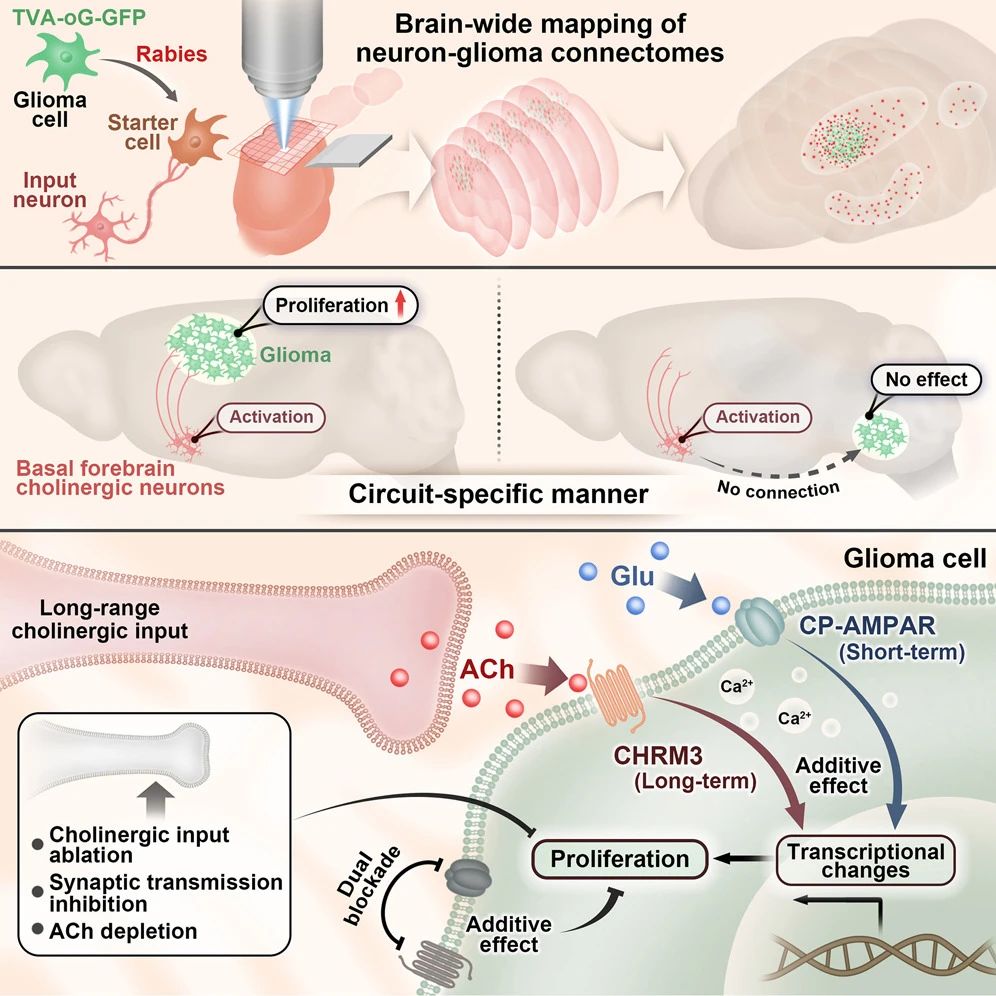
This article revolves around "How neuron-glioma interactions affect the
progress of glioblastoma (GBM)". The research ideas follow the logical
progression of "discovering connection patterns → verifying functional effects →
analytical mechanisms → exploring clinical transformation".
GBM is known to be integrated into neural circuits, and local glutamategic
synaptic input has been shown to promote tumor progression, but the overall
architecture of neuron-glioma connections (especially the role of remote neural
circuits and diverse neurotransmitter systems) is not yet clear. Based on this,
the research focuses on: What is the connection pattern between GBM and
whole-brain neurons? Does remote neural input (especially the neuromodulation
system) participate and affect GBM progress?
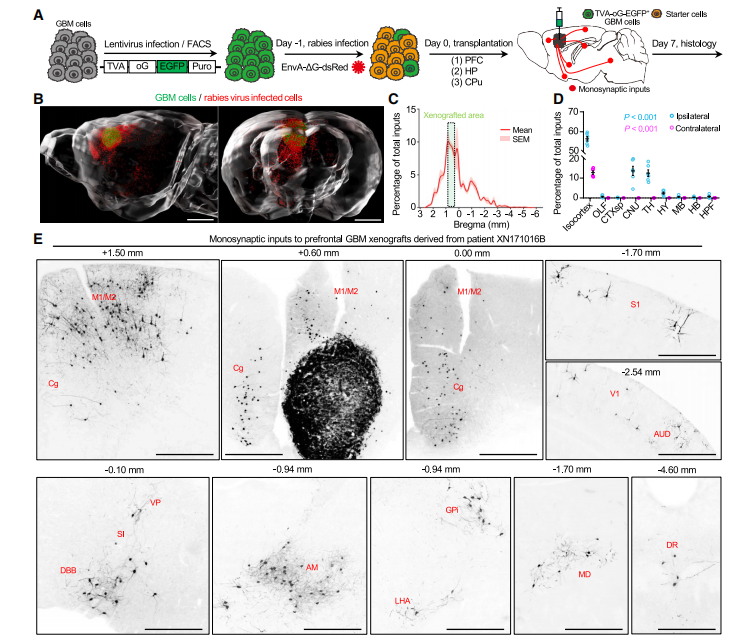
Draw the whole-brain neuron-glioma connection map
In order to analyze the connection architecture of neuron-glioma, the study
used single-synaptic rabies virus tracing technology to conduct whole-brain
input mapping of patient-derived GBM cells transplanted into different brain
regions such as the prefrontal cortex, hippocampus, caudal puta, etc., combined
with fMOST whole-brain imaging and molecular marker analysis, it was found
that:
The connection pattern has spatial organizational rules: local input is
mainly glutamate neurons, remote input comes from subcortical nuclei, and there
are various types of neurotransmitters;
Basal forebrain cholinergic projections (such as Broca beveled nucleus) are
conservative remote inputs across tumor locations and patient sources, and are
the core research subjects.
Verify the connection between the remote cholinergic input and GBM
After clarifying the structural connection, it was observed through
immunoelectromics that there was a symmetric synaptic structure between the
basal forebrain cholinergic axons and GBM cells, which was consistent with the
typical morphology of cholinergic synaptics.
Further, optogenetic activation of cholinergic neurons can trigger
sustained calcium transients in GBM cells, and this reaction can be completely
blocked by acetylcholine receptor antagonist, confirming acetylcholine
(ACh)-mediated functional ligation.

Analyzing the mechanism by which cholinergic input promotes GBM
progress
Regarding "How cholinergic input drives GBM progress", the study explores
three aspects: receptor, loop specificity, and coordination with other
signals:
Key receptor identification: Through CRISPR knockout experiment, it was
found that knocking out the muscarinic receptor CHRM3 alone can inhibit
ACh-induced GBM proliferation, and the high expression of CHRM3 is related to
poor patient prognosis, confirming the necessity of CHRM3;
Circuit specificity: When GBM is transplanted to the medulla of the medulla
without basal forebrain cholinergic input, activation of cholinergic neurons
cannot promote tumor growth, confirming that the effect depends on direct neural
connections;
Synergistic with glutamategic signal: Calcium imaging shows that ACh and
glutamate can superimpose the calcium transients in GBM cells. Transcriptome
analysis found that there was a time difference in the regulation of gene
expression (glutamate effect is short and ACh is durable), suggesting a
non-redundant synergistic mechanism.


Explore clinical transformation potential and verify treatment
strategies
Based on mechanism research, the anti-tumor effects of approved drugs are
tested, providing a basis for clinical applications:
The muscarinic receptor antagonist hyosamine can inhibit GBM growth and
prolong the survival of model mice;
The acetylcholinesterase inhibitor donepezil (increasing ACh levels) will
accelerate the progression of GBM, suggesting that clinical use should be used
with caution;
Combined blocking of the cholinergic (hyopamine) and glutamate (perampanel)
pathways, or combined with the standard chemotherapeutic drug temozolomide,
produces superimposed anti-tumor effects and verify the potential of combined
treatment.
In summary, from "structural connection" to "functional mechanism" to
"clinical transformation", the systematic reveals the role of remote cholinergic
input in the progression of GBM, providing new ideas for the treatment of
targeted nerve-tumor interactions.